
Priority Encoder with Valid Flag
Problem Description
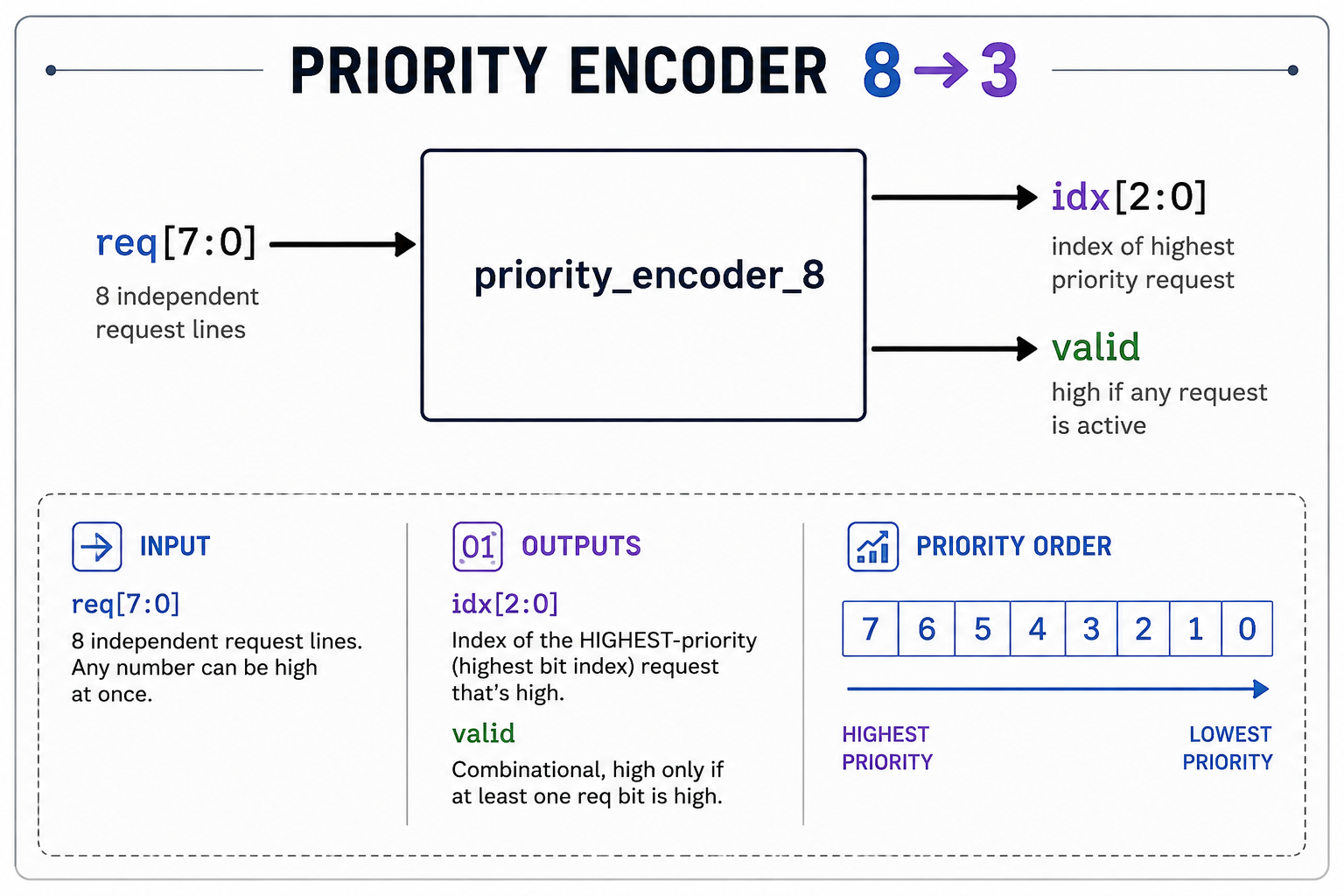
Design a fully combinational priority encoder. Given an 8-bit req bus where any number of bits may be asserted simultaneously, output idx = the bit position of the highest-indexed asserted bit (bit 7 has top priority, bit 0 has lowest). Assert valid whenever any bit of req is high; when req is all-zero, idx should be 3'b000 and valid should be low.
Interface Table
Port | Direction | Width | Description |
|---|---|---|---|
req | input | 8-bit | Request lines; any number can be high |
idx | output | 3-bit | Combinational, index of highest-priority high bit |
valid | output | 1-bit | Combinational, high if any req bit is high |
Edge Cases
req == 8'b0000_0000 → idx = 0, valid = 0
Only req[0] high → idx = 0, valid = 1
Multiple bits high (e.g. req[3] and req[6] both high) → idx = 6 (higher index wins)
All bits high (8'hFF) → idx = 7
All Scenarios
Scenario | Key State | Output fires? |
|---|---|---|
No requests | req == 0 | valid = 0 ✗ |
Single request, low bit | req[0]=1 | valid=1, idx=0 ✓ |
Single request, high bit | req[7]=1 | valid=1, idx=7 ✓ |
Multiple requests, priority resolves | req[2],req[5]=1 | valid=1, idx=5 ✓ |
All requests high | req==8'hFF | valid=1, idx=7 ✓ |
Hints
Hint 1: This is a purely combinational module — no clk or reset port needed at all.
Hint 2: Think of it as a priority if-else chain, checked from the HIGHEST bit down to the lowest.
Hint 3: valid is simply "OR of all req bits" — you can compute it separately from idx.
Hint 4: Structure: one always @(*) block with a priority if-else if-...-else checking req[7] down to req[0], with a final else covering the all-zero case.
Verilog
Code Editor Access
Log in to write, run and submit your solution to this interview question. It's free.