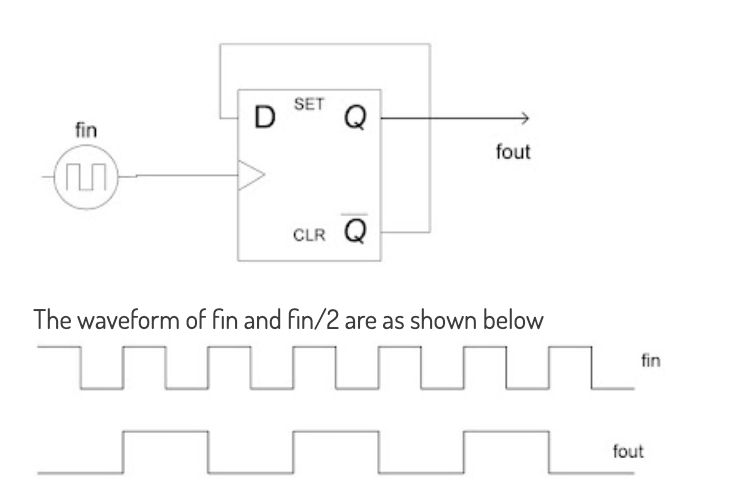
Consider the flip-flop circuit shown in the diagram, which acts as a "divide-by-2" clock frequency divider. The timing parameters for the flip-flop are as follows:
Setup Time (Tsetup): 6 ns
Hold Time (Thold): 2 ns
Clock-to-Q Delay (Tclk−q): 10 ns
Combinational Logic Delay (dly): 0 ns
Which of the following statements correctly describes the timing performance of this circuit?
Data setup time: 6 ns
Hold time: 2 ns
Clock-to-Q delay: 10 ns
To achieve a clock frequency divided by 2, a D flip-flop is used with its inverted output connected back to its input.
1. Formula for Minimum Clock Period (T_minimum):
T_minimum >= T_setup_time + T_clock_Q + dly
2. Calculation:
T_minimum >= 6 ns + 10 ns + 0
T_minimum >= 16 ns
3. Maximum Frequency (f_maximum) calculation:
f_maximum = 1 / 16 ns
Result: 62.5 MHz
The maximum possible frequency of operation for this circuit is 62.5 MHz.
To determine if there is a hold time violation, we must check if the hold time constraint is satisfied.
1. Hold Time Constraint Formula:
T_hold <= T_clk-q + dly
2. Calculation:
2 ns <= 10 ns + 0
2 ns <= 10 ns
Conclusion:
Since the condition is satisfied (2 ns is less than 10 ns), there is no hold time violation in this circuit based on the given timing requirements.
