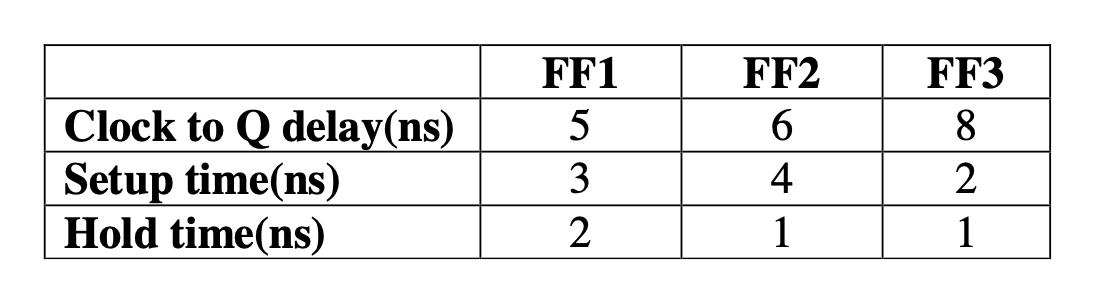
Using the timing parameters provided in the table below for three different flip-flops, which flip-flop (FF) can operate at the highest (maximum) frequency when used in a simple shift register configuration (assume combinational delay dly=0 ns)?
Understand Maximum Frequency: The maximum frequency (fmax) of a flip-flop is the inverse of the minimum clock period (Tmin).
Calculate Minimum Clock Period (Tmin): The formula for the minimum clock period is Tmin≥Tclk−q+dly+Tsetup. Assuming dly=0 ns:
FF1: Tmin=5 ns+3 ns=8 ns
FF2: Tmin=6 ns+4 ns=10 ns
FF3: Tmin=8 ns+2 ns=10 ns
Determine the Highest Frequency: The flip-flop with the smallest Tmin will have the highest fmax.
fmax for FF1 =1/8 ns=125 MHz
fmax for FF2 =1/10 ns=100 MHz
fmax for FF3 =1/10 ns=100 MHz
Since FF1 has the shortest required clock period (8 ns), it can operate at the highest frequency.
